

Comment 49 - Operational Supervisors: the Most Critical Link
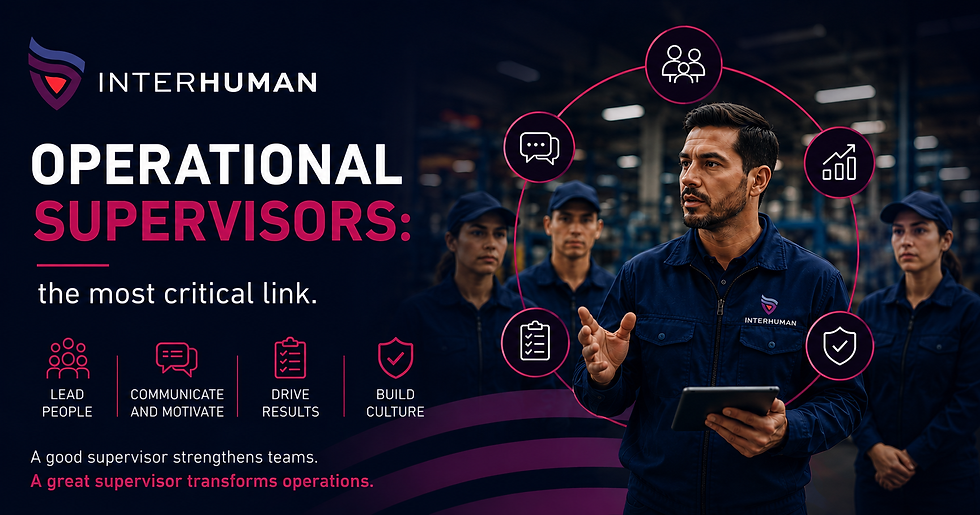
In many companies, especially in industrial, logistics, commercial, or service operations, there is one position that is often underestimated while simultaneously having the power to determine much of the daily success or failure of the operation: the operational supervisor.
Most companies invest time hiring managers, coordinators, and directors. They also invest resources recruiting operators, technicians, or frontline workers. But very few stop to analyze the enormous impact of the person standing right in the middle of both worlds: the supervisor.
An operational supervisor does far more than manage people. They also transmit company culture, enforce discipline, execute processes, resolve conflicts, train employees on the floor, follow up on KPIs, and, in many cases, become the real face of the company for the workforce.
A good supervisor can stabilize a difficult operation.A bad supervisor can destroy an entire team within weeks.
And this is where one of the most common mistakes in Human Resources and operations appears: promoting the best operator into a supervisor role… without preparing them to lead people.
Being an excellent operator does not automatically mean having leadership, communication, or conflict-resolution skills. In fact, the opposite often happens: the new supervisor fully understands the technical work but does not know how to lead teams, correct behaviors, or manage pressure.
That is when problems begin:
High turnover.
Poor work environment.
Absenteeism.
Low productivity.
Internal conflicts.
Constant complaints.
Lack of follow-up.
Loss of operational discipline.
In many cases, when a company believes it has a “staffing problem,” what it actually has is a supervision problem.
Operational supervisors are also under pressure from both sides. Management demands results, productivity, and compliance, while frontline employees expect support, empathy, and quick solutions. It is a highly demanding position.
That is why one of the biggest current challenges in Human Resources is the professionalization of operational supervision.
Today, it is no longer enough to simply place someone “in charge.” Companies need supervisors who know how to:
Lead people.
Resolve conflicts.
Communicate effectively.
Manage KPIs.
Apply discipline.
Motivate teams.
Train employees on-site.
Detect workplace risks.
Handle pressure and stress.
And there is another important point: operational supervisors themselves often do not receive enough tools or training. Companies expect a lot from them, but formal leadership development is rarely provided.
In challenging labor markets such as Monterrey and its metropolitan area, where turnover and competition for operational talent continue to intensify, supervisors can become a company’s main competitive advantage.
Because operational employees usually do not quit the company itself. They quit poor environments, poor treatment, or poor supervision.
Organizations that understand this will achieve more stable operations, lower turnover, and higher productivity levels.
In Human Resources, we often talk about strategy, organizational culture, and leadership. But in the daily reality of a plant, warehouse, retail store, or distribution center, much of that culture depends directly on the operational supervisor.
And that is why they remain, quite possibly, the most critical link in the entire operation.
Manuel Gonzalez


Comments